What Pingo AI Does Well
Credit where it's due. Pingo gets a few important things right:
- It's easy to start talking. There's little standing between opening the app and being in a conversation. You pick a scenario and you're talking within seconds. For people who freeze up speaking to a human, that low-pressure entry point is valuable.
- Natural-sounding voices. The AI voices are pleasant, you can slow them down, and you can ask them to repeat. This makes early listening practice less intimidating.
- Two useful modes. Tutor Mode gives guided dialogues for beginners, and Role-Play Mode simulates real conversations. There are 200+ scenarios plus the ability to create custom ones.
- Broad language support. Pingo markets 25+ languages, so most learners will find their target language covered at a basic level.
If your only goal is to build the habit of speaking out loud, Pingo can help you do that.
Two Conversations That Show the Problem
To see how meaningful Pingo's scores actually are, I ran two deliberately bad conversations. Both got praised.
The first was a market-seller roleplay. The AI asked if I wanted three apples for 10,000 won. I replied with a single syllable: "네" (yes). It thanked me, told me to come again, and ended the conversation. Total time: 25 seconds. Pingo gave me 78 out of 100 overall, including 80 for grammar and 78 for vocabulary, for a conversation where I said one word.
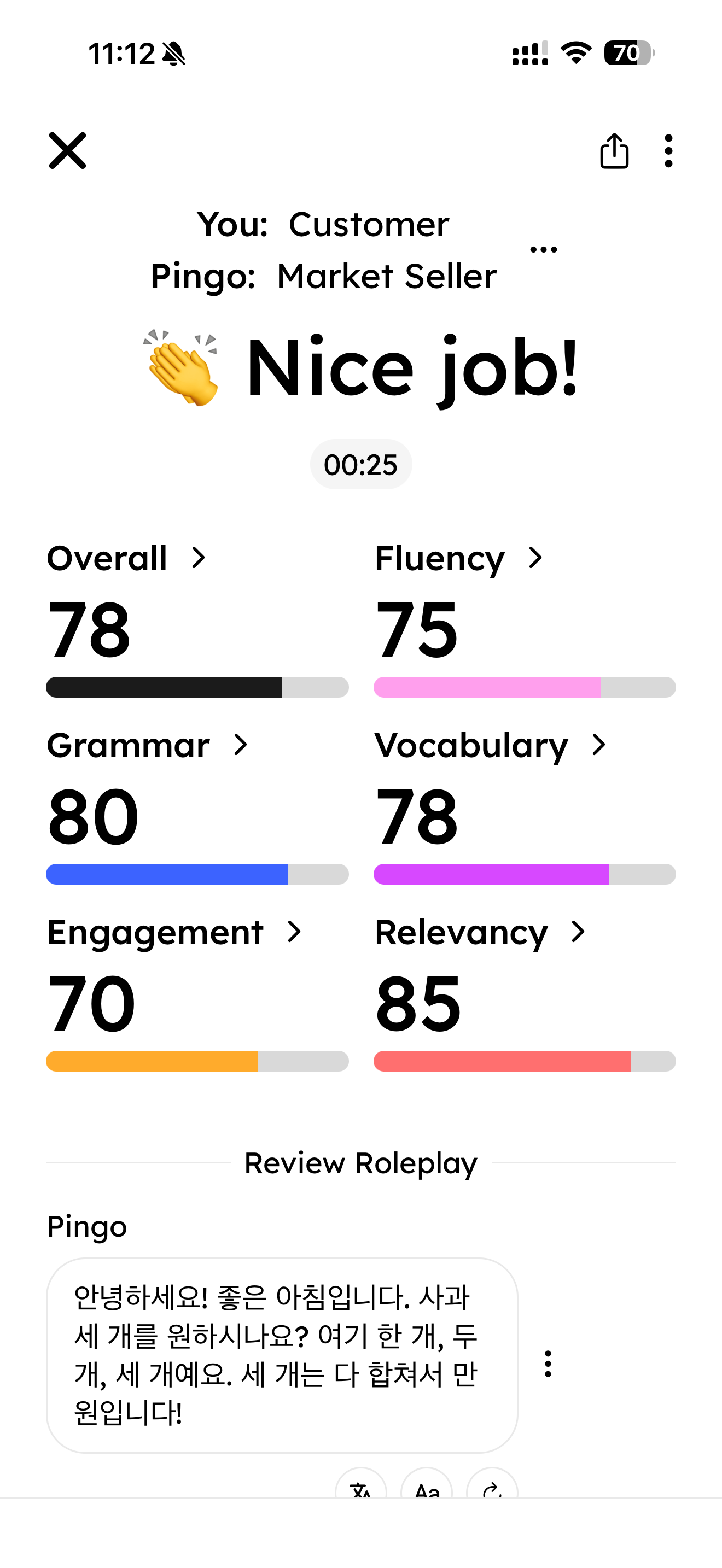
Pingo scored this 78/100 overall, for a conversation that lasted 25 seconds.
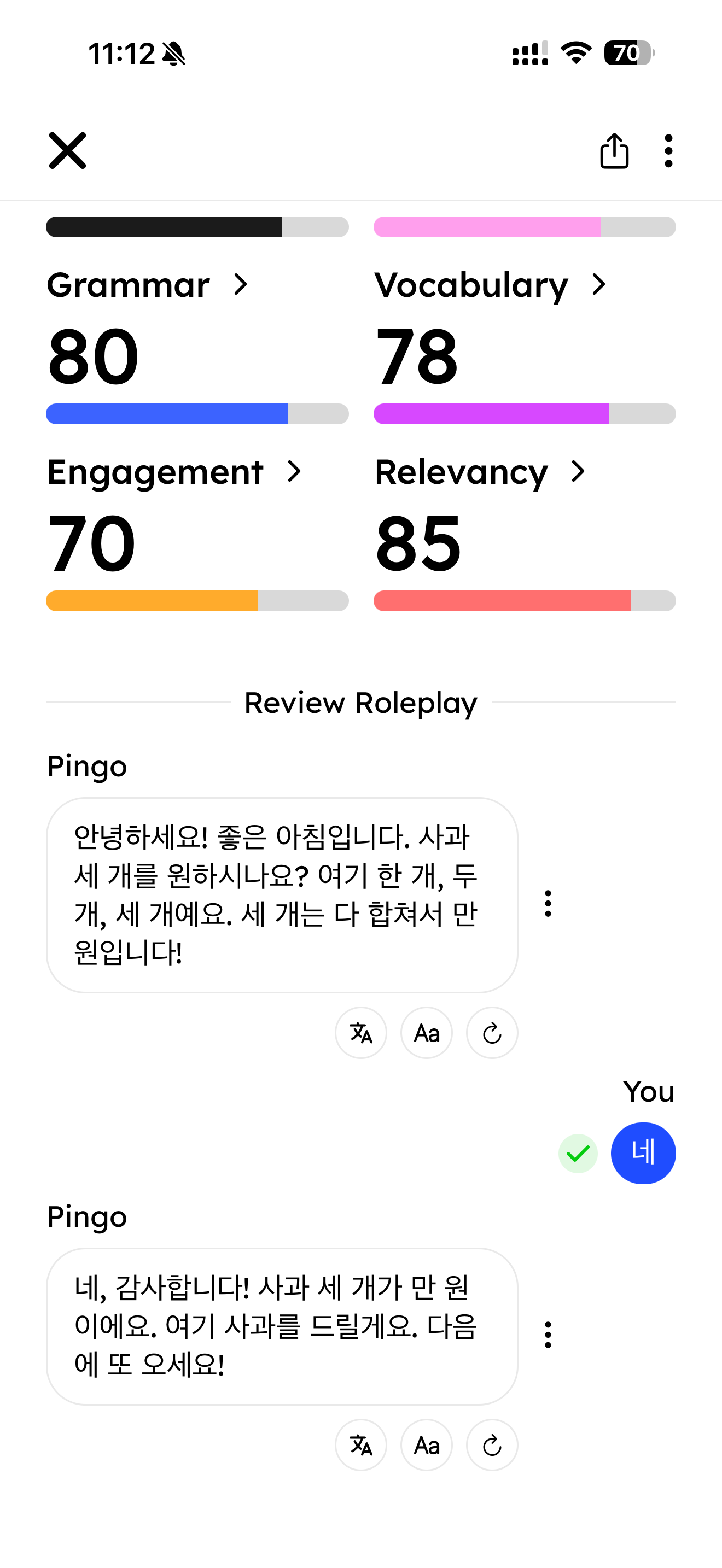
The entire conversation. My only contribution was "네" (yes).
For the second, a tourist roleplay, I stopped speaking Korean altogether. I typed, in English: "I have no clue what you said. I put it on level 2 for my Korean. And you are using a lot of very hard Korean words. I don't know what you're saying."
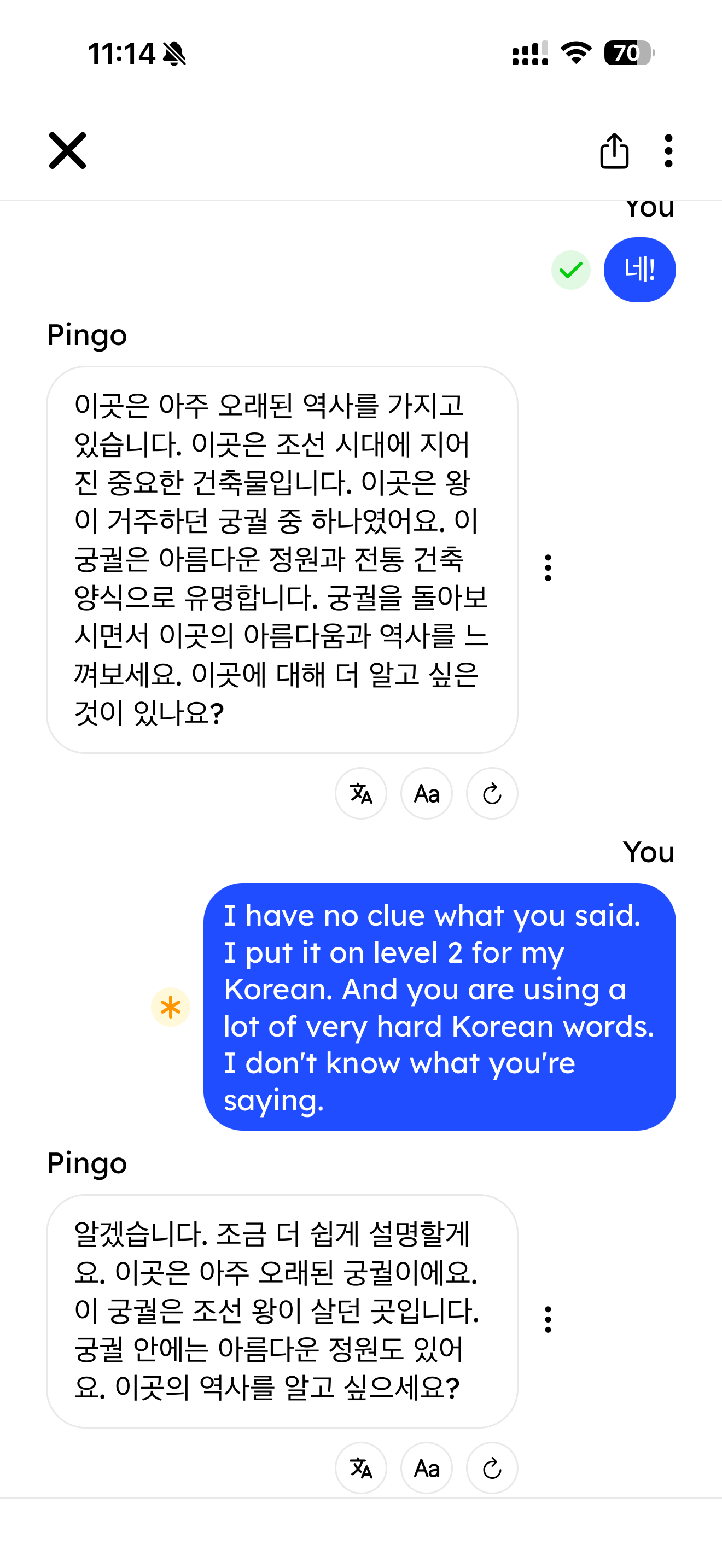
I told Pingo, in English, that I couldn't understand it.
Instead of flagging that I'd switched languages, Pingo just went along with it and started replying in English too. The rest of the "Korean practice" session played out as a plain English conversation.
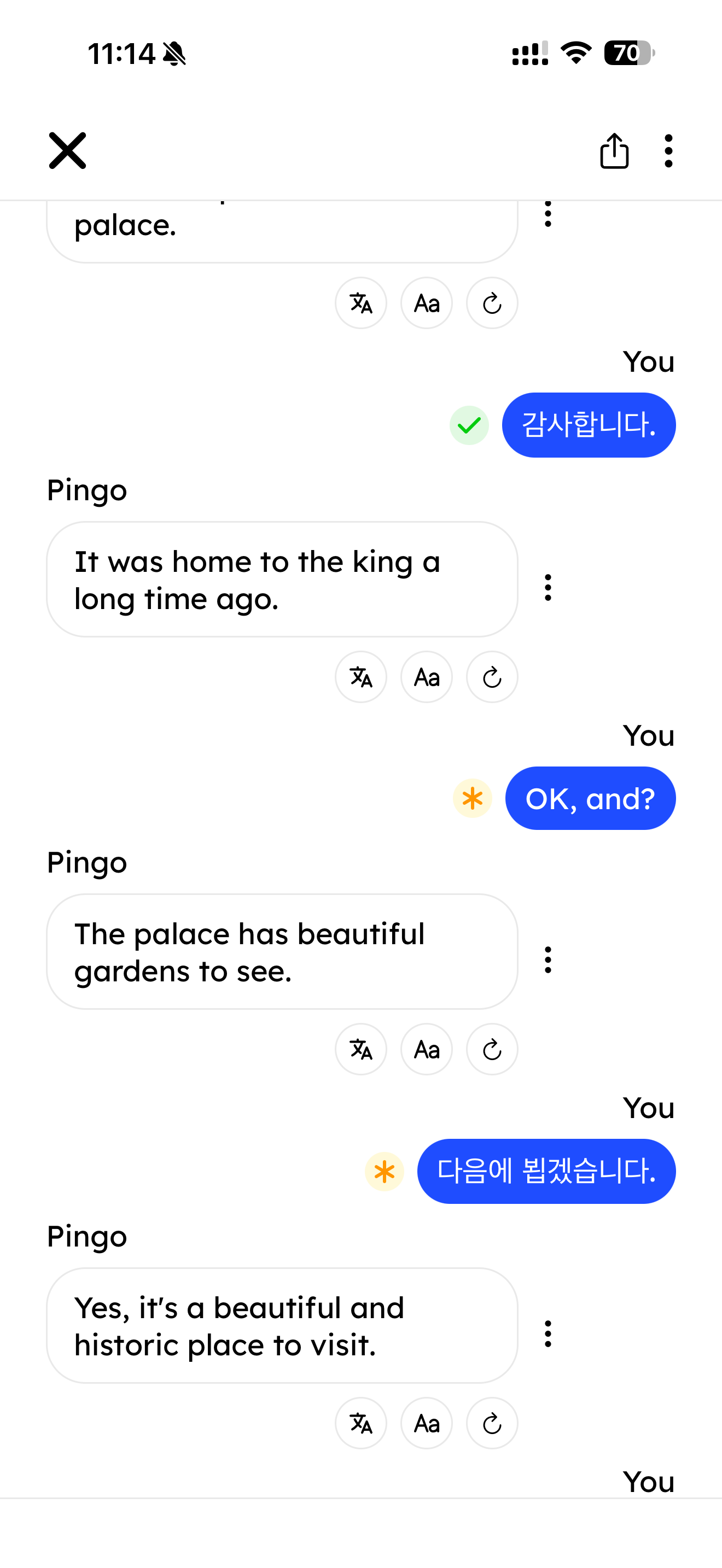
From there the whole exchange was in English, both my side and Pingo's.
That session scored 80 out of 100.
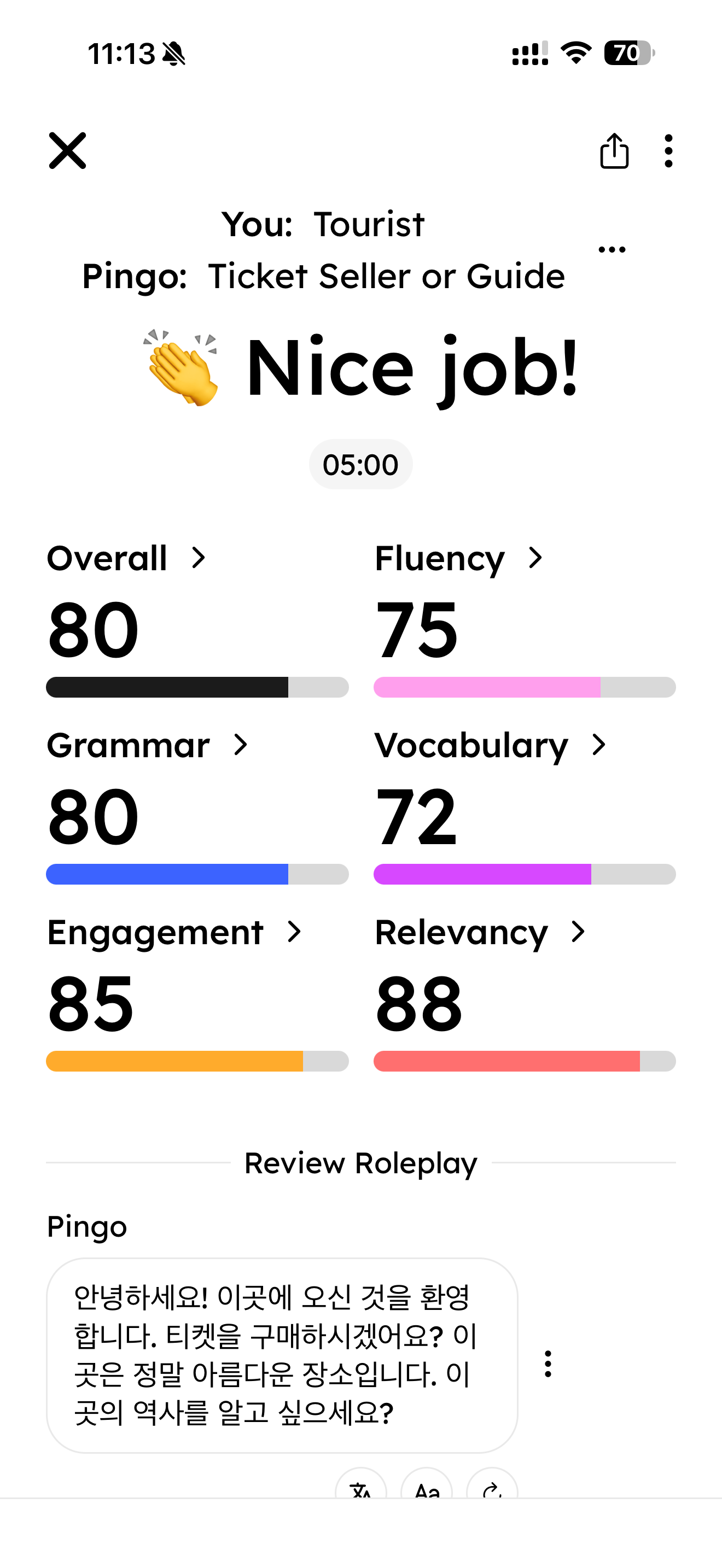
80/100 overall, including 80 for grammar, for a Korean session held entirely in English.
A scoring system that returns 78 for one word and 80 for a conversation in English isn't measuring your Korean. It's barely measuring anything. And because the numbers look encouraging, they actively work against you, handing out a sense of progress you haven't earned.
Where Pingo AI Falls Short
The speech recognition is too lenient
This is the biggest problem, and it undermines the app's core promise. In testing, Pingo routinely accepts pronunciation that's clearly wrong. Reviewers have deliberately said words incorrectly, and even spoken nonsense syllables, and the app still accepted the response and praised the effort.
For a speaking app, this is a serious flaw. The entire point of practicing pronunciation is to be corrected when you're wrong. If the app tells you that everything you say is fine, you end up practicing and reinforcing mistakes without ever knowing it. That's worse than no feedback, because it builds false confidence.
The feedback is shallow
After a conversation, Pingo gives you a brief summary and a "mastery" percentage. But the feedback doesn't break down specific grammar errors, analyze your pronunciation patterns, or track the mistakes you keep making. You're told you did well, but not what you actually did well or poorly, or what to focus on next.
The scores make this worse, not better. As the two conversations above show, you can score in the high 70s or 80s while saying almost nothing, or while not speaking the language at all. A number that high after that little effort gives a misleading sense of progress.
The content stays at beginner level
Pingo's scenarios are oriented almost entirely toward beginners. Once you're past basic phrases and introductions, there isn't much to push you forward. There's also no spaced repetition, so vocabulary you "learn" is never systematically brought back, and grammar instruction is thin.
Bugs and the paywall
Users report crashes, audio lag, and conversations cutting off mid-sentence. The free experience is very limited (often a single conversation before the paywall), and there are repeated complaints about it being hard to find where to cancel the subscription.
Pingo AI for Korean
Pingo supports Korean and markets it heavily, with claims about teaching Hangul, verb conjugation, honorifics, and formal-versus-casual speech. On paper that's a great fit for Korean learners.
In practice, Korean is exactly where the lenient speech recognition does the most damage. Korean pronunciation depends on details that English speakers find hard: aspiration, tense consonants, and final batchim sounds. An app that accepts "close enough" pronunciation can't help you fix any of that. And the honorific and formality system is too important to get casual feedback on. If you're serious about Korean, you want an app that actually catches these errors. (Not sure where you stand? Take our free Korean level test to find your TOPIK level first.)
Pricing
Pingo AI is subscription-only after a very limited trial:
- Monthly: around $14.99 to $17.99 a month as of September 2026
- Annual: around $83.99 to $99.99 a year as of September 2026
- Free trial: 7 days, card required
There's no meaningful free tier. You typically get one short lesson before hitting the paywall, which makes it hard to properly evaluate the app before paying. Recent App Store reviews repeatedly mention being charged around the end of the trial, subscriptions started through an external payment processor, and trouble finding where to cancel.
The Better Alternative: Lingrow
If Pingo's shallow feedback and lenient corrections are the dealbreaker, Lingrow is built to fix exactly those gaps.
The core difference is feedback quality. During conversations, Lingrow corrects your pronunciation and grammar in real time. After each conversation, you get a detailed breakdown covering grammar accuracy, vocabulary, fluency, and pronunciation, with specific tips on what to work on next. It's the level of detail Pingo's mastery percentages never reach.
Lingrow also doesn't just throw you into conversations. Its 100+ guided lessons have an AI tutor teach you the vocabulary and grammar first, then you practice it in a roleplay. So you're building on a foundation instead of guessing. With 350+ scenarios across 15 languages, the content holds up well past beginner level.
Where Lingrow is stronger than Pingo:
- Far deeper post-conversation feedback
- Real-time grammar and pronunciation correction that actually catches errors
- 100+ guided lessons that teach before you practice (Pingo has no equivalent)
- Content that stays challenging into intermediate and advanced levels
Where Pingo is still ahead:
- Available on Android (Lingrow is iOS only)
- More total languages (25+ vs. 15)
Pingo AI vs. Lingrow
| Pingo AI | Lingrow | |
|---|---|---|
| Speech recognition | Too lenient, accepts errors | Catches and corrects errors |
| Post-conversation feedback | Brief, with a mastery % | Detailed grammar, vocab, fluency, pronunciation |
| Guided lessons | No | 100+ with AI tutor |
| Content depth | Beginner-focused | Beginner to advanced |
| Languages | 25+ | 15 |
| Platforms | iOS, Android, Web | iOS |
| Price | $14.99 to $17.99/mo | One subscription, free trial |
The Verdict
Pingo AI is a well-made app that does one thing well: it lowers the barrier to speaking out loud. For a complete beginner who's terrified of making mistakes in front of a real person, that's worth something.
But a speaking app that doesn't reliably correct your speaking has a hole at its center. The lenient recognition, shallow feedback, and beginner ceiling mean most learners will outgrow it quickly, and some will pick up bad habits along the way.
For a side-by-side breakdown of the two apps, read our Pingo AI vs Lingrow comparison. If you've already decided to move on, our ranked list of the best Pingo AI alternatives covers Lingrow and eight other apps with current prices.
If you want practice that actually makes you better, look for an app with feedback you can trust. For a deeper comparison of the whole category, see our guide to the best AI language learning apps, and if you're focused on Korean, our best AI Korean speaking practice apps ranking goes deeper on what works.
