What Lingotok Does Well
To be fair, a few things work:
- Low-pressure speaking practice. Some learners with speaking anxiety genuinely value that the AI doesn't judge them and just keeps the conversation going. If your biggest barrier is fear of speaking to a person, that's a real benefit.
- Speaking-first approach. Unlike apps built around tapping and matching, Lingotok puts you in a spoken conversation from the start. That focus is the right instinct.
- It listens to pronunciation. The app responds to how you say things, not just text, which is a step up from typing-based apps.
These are real positives. The problem is what surrounds them.
Where Lingotok Falls Short
No real free trial, and an aggressive paywall
The single most common complaint is that Lingotok asks for money before you can use it. There's no meaningful free trial, just a pay screen on entry. For an app you can't properly test first, that's a tough ask.
Confusing and aggressive billing
Reported prices vary a lot from user to user, from around $7 to $30 per week up to roughly $50 per quarter, which suggests heavy price testing. More concerning, several users report the subscription is sold as a web subscription rather than a standard App Store purchase, which makes it harder to cancel and may not qualify for Apple refunds. There are reports of unexpected and double charges.
Thin content with little structure
This is the core issue. Users describe lessons that teach only a couple of words across a 20-minute session, with no real curriculum or progression. It's essentially open-ended AI chat. For a beginner who needs scaffolding, "just talk to the bot" isn't a learning path.
Technical glitches
A recurring complaint is that the AI cuts off or stops responding around the eight to ten minute mark, requiring a restart, and that practice progress isn't always saved. Some users also report pronunciation guidance that sounds inaccurate, including a noticeably American accent on at least one tutor voice.
Support you can't reach
The support story is worse than the bugs. One paying user spent weeks in Lingotok's Discord reporting that the app wouldn't work with his AirPods, and was routinely ignored. I know because I ended up speaking with him directly. He was paying for the app, and that was the level of help he got. Since then, Lingotok's Discord has been effectively shut down, members can no longer post in it, so even that channel for reaching the team is gone.
What the aggregators say
The app stores show a relatively high rating, but it sits oddly against the volume of billing complaints. One third-party review aggregator scored Lingotok very poorly on legitimacy based on an automated analysis of thousands of reviews. That's a directional signal rather than a verdict, but the gap between the polished store rating and the complaint volume is worth noting.
Lingotok for Korean
Korean is one of Lingotok's most-promoted languages on social media, and it does support it. But Korean learners are the source of several of the harshest complaints: lessons that teach only a few words before trying to wrap up, no structure for absolute beginners, sessions glitching out, and pronunciation guidance that can sound off.
Korean is a language where structure matters a lot. You need to learn Hangul, get pronunciation details right, and understand formality levels. An unstructured "talk to the bot" experience leaves beginners without the foundation they need. (If you want to know your actual level first, our free Korean level test takes a few minutes.)
Pricing
Lingotok is paywalled almost immediately, with no genuine free trial. Pricing also shifts from user to user, but a typical paywall looks like this:
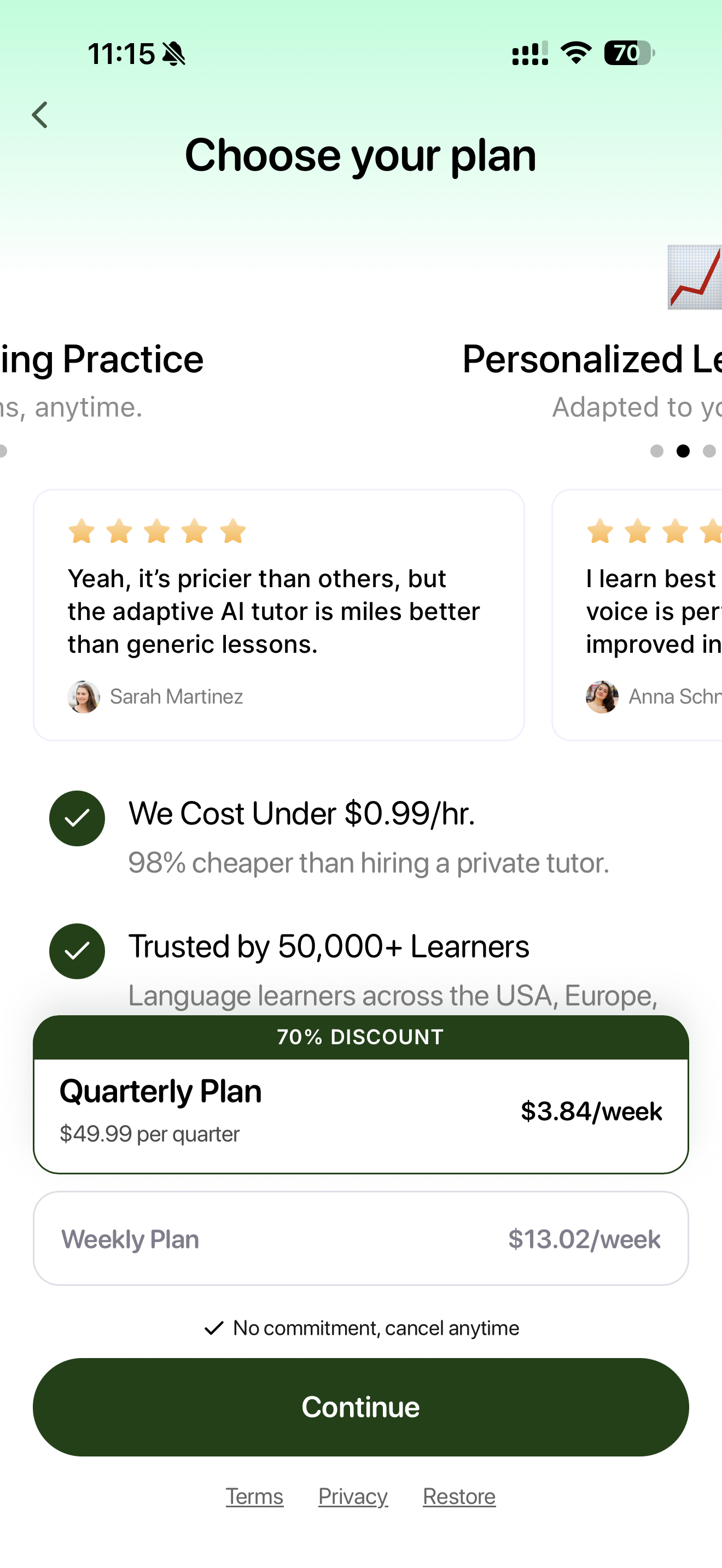
A Lingotok paywall. The "weekly plan" is priced at $13.02 per week.
Watch the weekly option. At $13.02 per week, that's over $675 a year for a single-feature AI chat app, far more than far more capable apps charge. The quarterly plan ($49.99) is cheaper but still works out to around $200 a year. Reported prices elsewhere range from roughly $7 to $30 per week depending on the offer shown.
Because some subscriptions reportedly route through a web checkout rather than the App Store, check carefully how to cancel before you pay.
The Better Alternative: Lingrow
If you like the idea of speaking practice but want something with actual substance behind it, Lingrow is built differently.
Instead of open-ended chat with little progression, Lingrow gives you 350+ structured conversation scenarios and 100+ guided lessons where an AI tutor teaches you the vocabulary and grammar first, then has you practice it. After every conversation, you get a detailed breakdown of your grammar, vocabulary, fluency, and pronunciation, with specific tips on what to improve. That's the structure and feedback Lingotok lacks.
It's also a normal App Store subscription, so there's no confusion about how billing or cancellation works.
Where Lingrow is stronger than Lingotok:
- Structured curriculum instead of open-ended chat
- Detailed, specific feedback after every conversation
- 100+ guided lessons that teach before you practice
- Standard App Store billing
Lingotok vs. Lingrow
| Lingotok | Lingrow | |
|---|---|---|
| Structure | Open-ended chat | 350+ scenarios + 100+ guided lessons |
| Feedback | Basic session report | Detailed grammar, vocab, fluency, pronunciation |
| Free trial | None reported | Standard trial via App Store |
| Billing | Often web subscription, hard to cancel | Standard App Store subscription |
| Stability | Reports of cutoffs and lost progress | Stable |
| Platforms | iOS, Android | iOS |
The Verdict
Lingotok's underlying idea (speaking practice with an AI tutor) isn't a bad one. But the execution is thin, the paywall is aggressive, the billing draws frequent complaints, support is hard to reach when something breaks, and the content doesn't give beginners a path to follow.
If you tried Lingotok and felt like you paid for an empty room, that's a common experience. For speaking practice that's actually structured and gives you feedback worth acting on, see our guide to the best AI language learning apps. Korean learners should also read our best AI Korean speaking practice apps ranking.
