What Langua Does Well
Langua earns a lot of its praise:
- Debate mode. You can debate the AI on custom topics, and the follow-up questions push you to use more complex grammar. It's a genuinely nice feature.
- A real vocabulary loop. You save unknown words mid-conversation, review them with spaced repetition, and the words get woven back into future conversations and AI-generated stories. That's smart and well-built.
- Strong feedback depth. You get inline corrections, optional verbal corrections during the chat, and a post-conversation feedback report.
- Good for reducing speaking anxiety. The zero-judgment, talk-anytime format is a common point of praise.
- Natural-sounding voices, though that's standard now. Langua's voices sound natural, but so do those in most modern AI conversation apps, including Lingrow, because they're built on the same underlying speech technology. It's table stakes, not a real advantage.
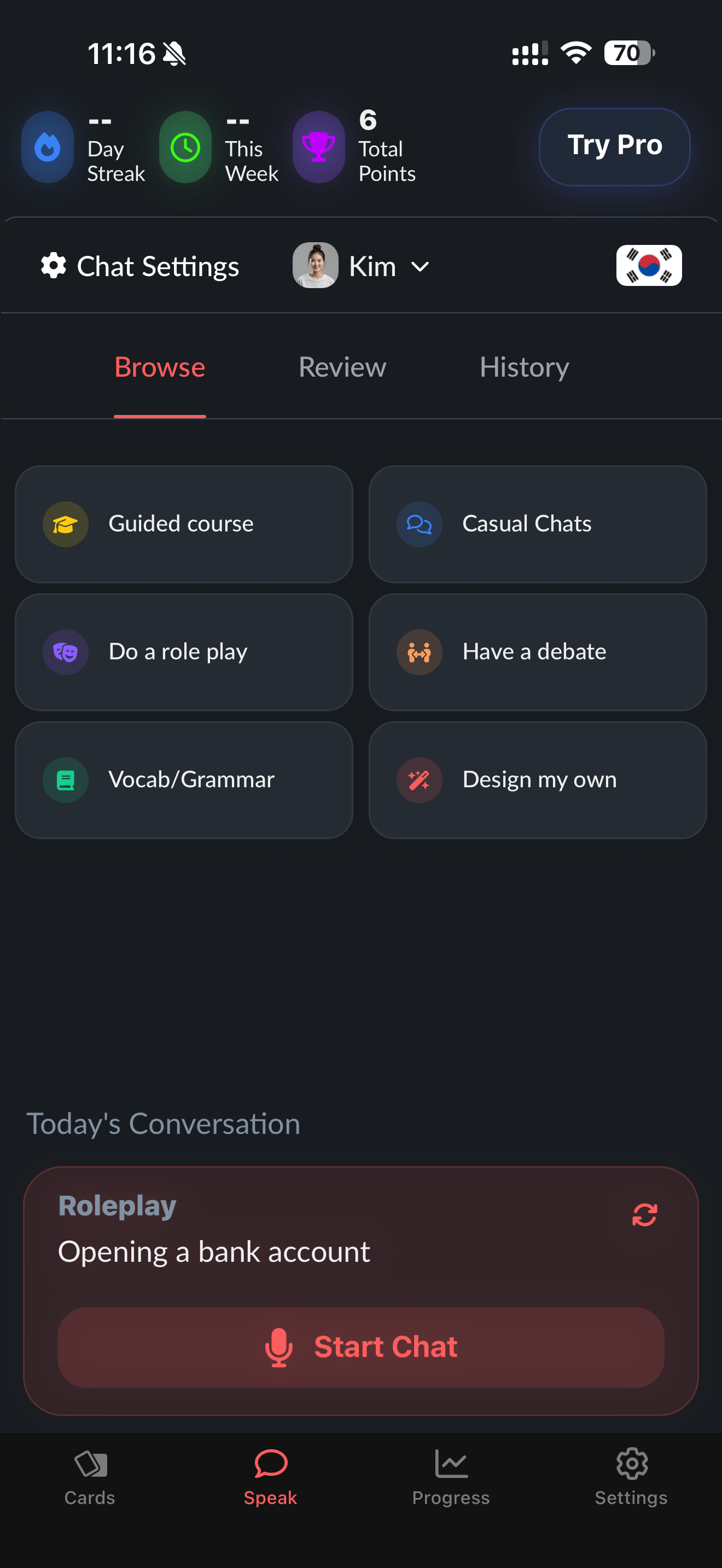
Langua's menu, including its debate mode and a beginner guided course.
Langua also has native iOS and Android apps plus a web version, so you can practice across devices. For a self-motivated intermediate or advanced learner, it's one of the better options out there.
Where Langua Falls Short
The price is high
This is a consistent complaint. In the app, Langua runs $99.99 per quarter or $299.99 per year, which is the equivalent of roughly $25 to $33 per month and sits at the higher end of the category. The free trial (7 days, card required) is short, and the free tier is too limited to seriously evaluate the app, just a few minutes of Call Mode per day.
Limited structure beyond beginner level
Langua has a Guided Course, but only for A1 and A2 beginners. Beyond that, there's no clear level-by-level path. You're expected to pick your own topics and direct your own learning. For self-motivated learners that's fine, even preferable. But if you want a curriculum that tells you what to study next, Langua mostly leaves that to you. There's also no formal placement test, so you set your own level.
Beginner friction
The interface isn't dumbed down, and several reviewers note a learning curve. For absolute beginners, especially in languages with non-Latin scripts, the experience can be harder to get into than it should be.
Some rough edges
Common bug reports include voice recognition struggling with strong non-native accents, the AI sometimes being unable to end a conversation naturally, and conversations feeling repetitive because the AI doesn't remember past sessions well. These are the kinds of issues most AI conversation apps share to some degree, but they're worth knowing.
Langua for Korean
LanguaTalk's own blog ranks Langua at the top for Korean, so take that with a grain of salt. The genuine picture is more nuanced.
It works fine as an option for intermediate Korean speaking practice. But there are two real limitations, both of which LanguaTalk is fairly open about. First, it currently lacks romanization for Korean, which makes it harder for absolute beginners who can't yet read Hangul.
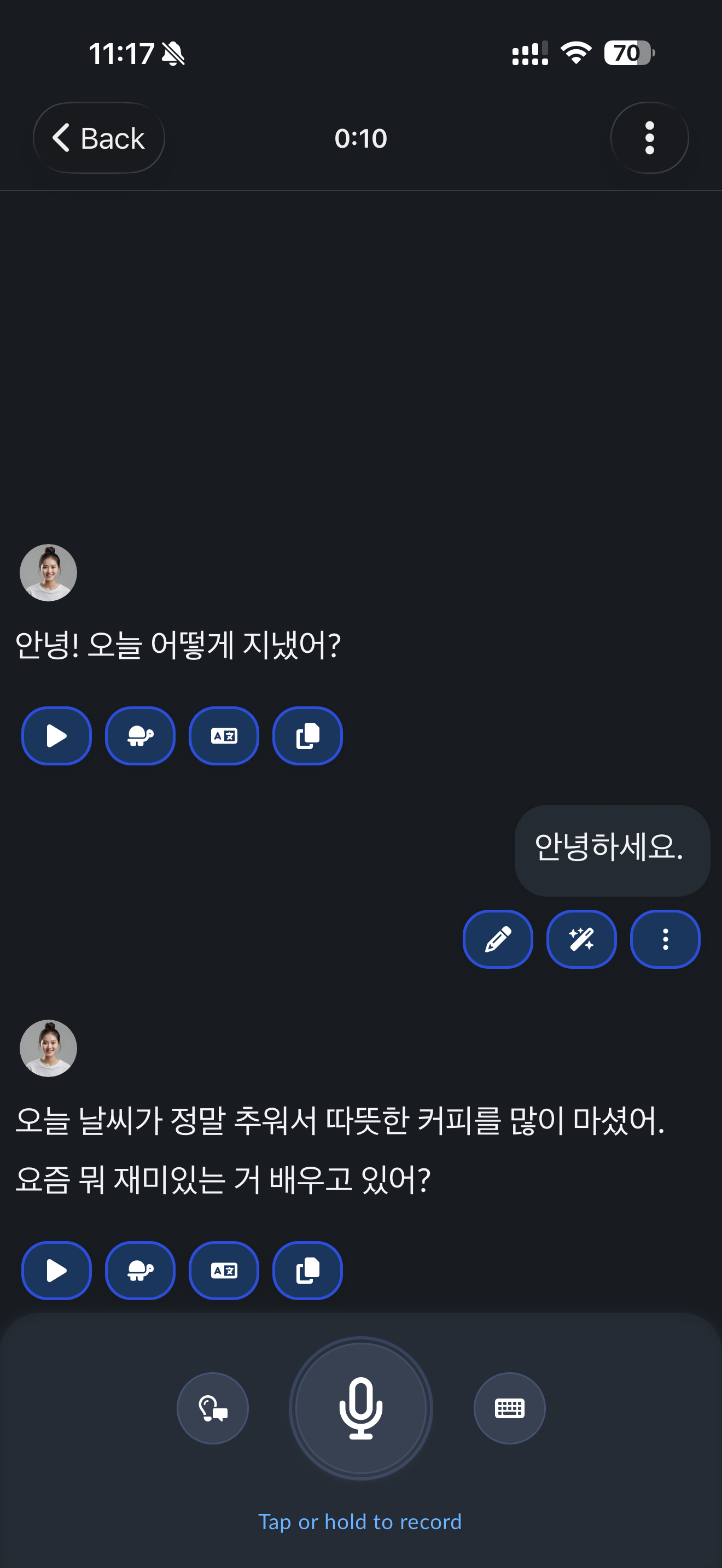
A Langua Korean conversation. Everything is in Hangul with no romanization, which is tough for beginners who can't yet read the script. Second, and more important, LanguaTalk's own FAQ notes that the AI "may not catch subtle mistakes in Korean formality levels," which are crucial in Korean. Getting honorifics and speech levels right is one of the hardest and most important parts of Korean, so an app that can't reliably correct them has a meaningful gap for serious learners. (To see where you stand, take our free Korean level test.)
Pricing
In the app, Langua is subscription-only, with no monthly option, just quarterly or annual:
- Quarterly: $99.99 per quarter (about $33/month)
- Annual: $299.99 per year (about $25/month)
- Free trial: 7 days, card required
- Free tier: very limited (a few minutes of Call Mode per day)
- No money-back guarantee on App Store purchases (it applies only to web and Android)
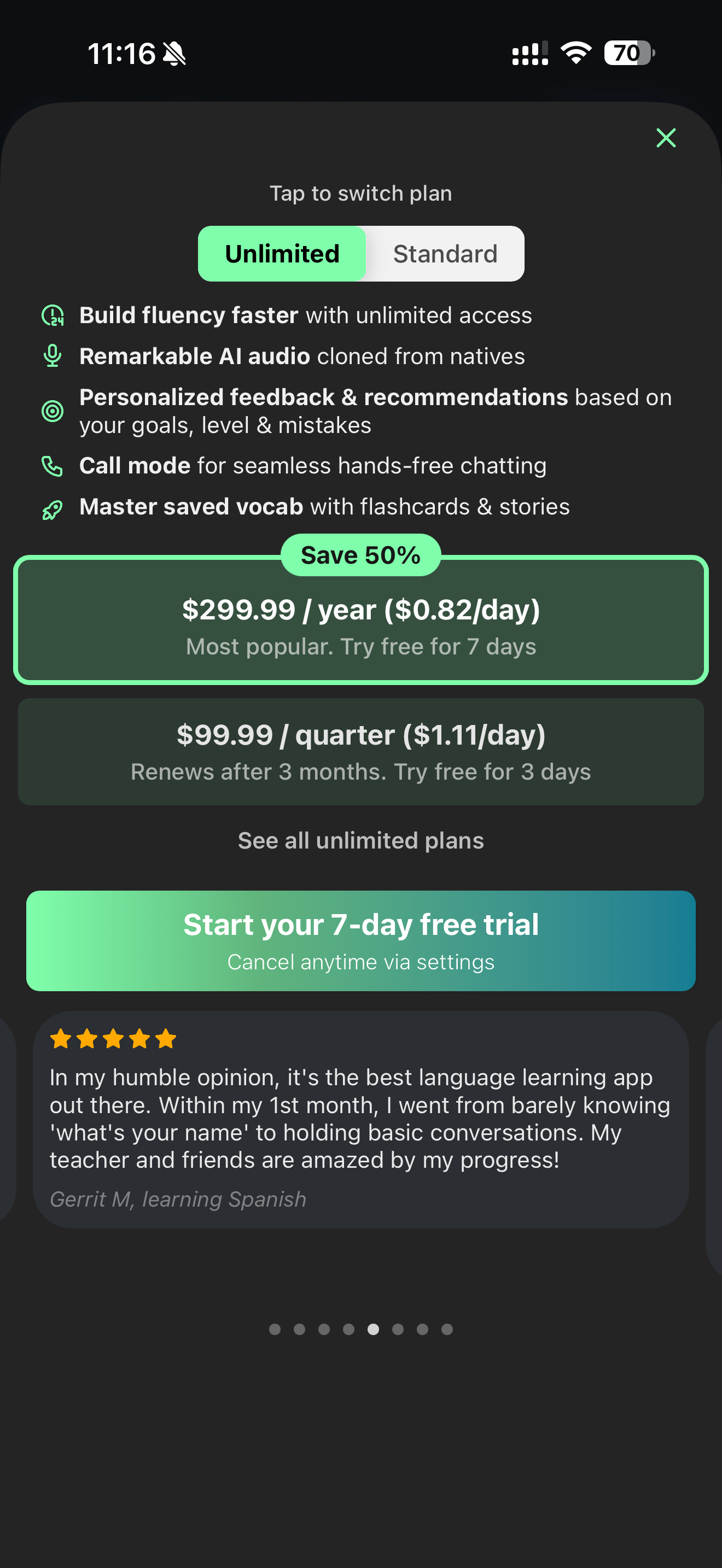
Langua's in-app pricing: $99.99 per quarter or $299.99 per year.
The Alternative: Lingrow
Langua and Lingrow take different approaches, and which is better depends on how you like to learn.
Langua is built around open-ended conversation, and it assumes you'll direct your own learning. Lingrow pairs conversation with structure. Its 100+ guided lessons have an AI tutor teach you the vocabulary and grammar first, then you practice it in a roleplay, so you're not left to figure out what to study next. With 350+ scenarios across 15 languages, plus detailed feedback on grammar, vocabulary, fluency, and pronunciation after each conversation, it's a better fit for learners who want a path rather than a blank page.
For Korean specifically, Lingrow's guided lessons and feedback are designed to handle the grammar and formality that learners need, which is the area Langua openly flags as a weak spot.
Where Lingrow is stronger than Langua:
- Structured guided lessons that teach before you practice
- A clearer path for beginners and lower-intermediate learners
- Built to handle Korean grammar and formality, not just conversation
Where Langua is stronger than Lingrow:
- Debate mode and a well-built vocabulary and spaced-repetition system
- Available on Android and web (Lingrow is iOS only)
Langua vs. Lingrow
| Langua | Lingrow | |
|---|---|---|
| Structured curriculum | A1/A2 only, then self-directed | 100+ guided lessons across levels |
| Feedback | Inline + verbal + report | Detailed grammar, vocab, fluency, pronunciation |
| Korean formality feedback | Flagged as unreliable by LanguaTalk | Built to handle it |
| Price | $99.99/quarter or $299.99/year | Paid subscription |
| Platforms | iOS, Android, Web | iOS |
The Verdict
Langua is a capable app, and for a self-directed intermediate or advanced learner who just wants conversation practice, it's a reasonable option. The honest caveats are the price, the lack of structure beyond beginner level, and, for Korean learners, the romanization gap and the formality feedback its own team flags as unreliable. If you want an app that actually teaches and corrects you rather than just talks back, Lingrow is the stronger pick.
If you want conversation practice that comes with a curriculum and teaches you before it tests you, it's worth comparing against the rest of the field. See our guide to the best AI language learning apps, and if you're focused on Korean, our best AI Korean speaking practice apps ranking.
If you're comparing Langua with other conversation apps, our TalkPal review and Praktika review cover two of the closest alternatives, including their prices and the billing complaints in recent reviews. For apps that correct your pronunciation while you speak, see the best language apps with real-time pronunciation feedback.
